Monday, 15 May 2017
NOISE: A Startling Case Of Two Schools In Proximity To Wind Turbines
In an effort to assist a society in danger, I feel obligated to make this case public. I am employed in schools within a rural area. The projects I am involved in run throughout the school year. I hope it will be understood why I cannot reveal names and locations. Sadly, I must protect myself against the professional consequences which could result from a fully detailed testimony.
During the past two years, I have worked in a school located 5 km to the east of a small wind farm, whose elevation is about 300 feet above that of the establishment. Most of the time, the school is downwind from the 2 MW wind turbines. In 2014/2015, I worked with the kindergarten consisting of 20 children aged 2.5 to 5 years of age. I’ve been engaged in this work for a long time, and I know the region and its people very well.
Full article HERE

Thursday, 9 March 2017

Tuesday, 7 February 2017
Cork Windfarm Families Update
Monday, February 06, 2017
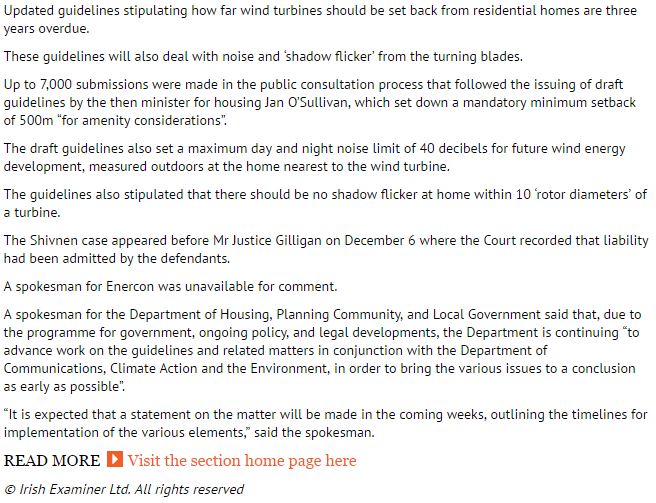
Seven Cork families could be on course to receive damages after a wind farm operator admitted liability in a High Court action over noise pollution.
Below is a saved page from Irish examiner as last time they issued this story they were told? to pull it down


Seven Cork families could be on course to receive damages after a wind farm operator admitted liability in a High Court action over noise pollution.
Below is a saved page from Irish examiner as last time they issued this story they were told? to pull it down


Friday, 6 January 2017
High Court to determine compensation for seven families in April hearing
PRESS RELEASE 4th January 2017
High Court order for families forced from homes due to noisy wind turbines.
High Court order for families forced from homes due to noisy wind turbines.
The High Court has issued its order regarding the seven families from Cork who were impacted by noise pollution from a nearby wind farm. A number of the families had to abandon their homes because of the severity of the noise and some lived up to a full 1km from the wind farm.
Here is link to court order:
https://gallery.mailchimp.com/e79075f1…/…/Order_Dec_2016.doc
https://gallery.mailchimp.com/e79075f1…/…/Order_Dec_2016.doc
The defendant, Enercon Wind Farm Services Ireland Ltd., has admitted liability and the case is listed for ten days in the High Court commencing 25th April 2017 to deal with damages and costs.
The outcome of the April court case could be a watershed for existing and planned wind farms as well as for investor confidence in, and government plans for the future of on-shore wind in Ireland. Many families, similarly affected by noisy wind turbines are anxiously awaiting the outcome and it is expected that more cases will now follow.
There has been a failure of successive governments to regulate the wind industry. Minister Denis Naughten is the latest minister to delay the introduction of regulation. This despite his promise to regulate the distance turbines can be placed from homes within 3 to 6 months of his taking office. Instead, yet another lengthy period of consultation is planned, despite previous consultations on the matter attracting over 7,000 submissions. A spokesperson from Wind Aware Ireland has stated “This further delay has indicated how far this government are prepared to allow the continuation of a free-for-all in the construction of wind farms, to the detriment of rural communities who are bitterly opposing their construction.”
Ireland’s embarked on an all-wind strategy in 2007 under Minister Eamon Ryan in conjunction with Brendan Halligan (chairman of SEAI), who at the time was also a director and shareholder in Mainstream Renewables, one of Ireland’s biggest wind farm developers.
No cost benefit analysis (CBA) or strategic environmental assessment (SEA) was ever carried out on the plan. Both of these legally required analyses were sidestepped.
To date, these analyses have not been carried out and Ireland proceeds with this expensive experiment. Ireland’s 1400 wind turbines have reduced our CO2 emissions by a paltry 3-4%.
Monday, 19 December 2016
UDATE Cork 7 Families IWEA Refute Enercon Claims For Liability
UPDATE: Hmm. Industry Body says it is all false? It’s a strange one. The original link has vanished from The Irish Examiner, and a pro renewables site SeeNews which covered their story has disappeared their copy too [cached here, screencap copy too]. SeeNews has posted an update which totally contradicts the news. Did The Irish Examiner get it wrong? Removing the story suggests they did, but they have not issued a correction yet. News of the update comes not from the court, but from the Irish Wind Energy Association, not exactly an impartial source. The IWEA flatly says that no one admitted liability, no families were forced from their homes, and there was no judgement or ruling? Yet the original story claimed all these things.
Full Story Here UPDATED. Big dollars at stake: Irish families win court case against wind farm noise (or not)
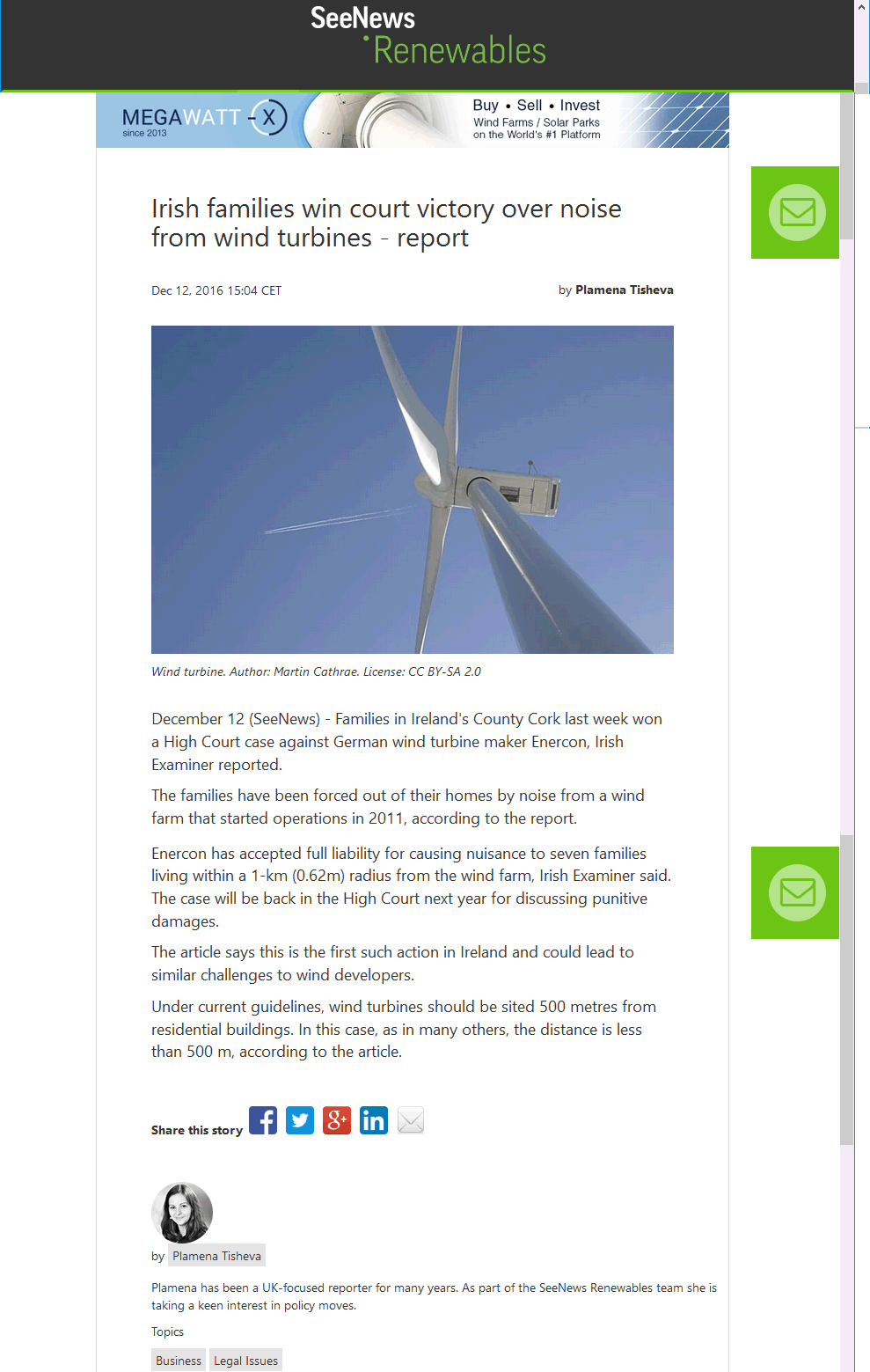
Full Story Here UPDATED. Big dollars at stake: Irish families win court case against wind farm noise (or not)
Monday, 12 December 2016
Families forced from homes due to wind farm noise win court case
A number of families in Co Cork who were forced to leave their homes because of noise from a nearby wind farm have won a significant case in the High Court this week.
The families claim they have been severely impacted by noise since the wind farm began operating in 2011.
This is the first action of its kind in Ireland and may now open many wind farm developers to the prospect of legal challenges from families in similar situations.
advertisement
The case was taken against wind turbine manufacturer Enercon who have accepted full liability for causing nuisance to seven families who live up to 1km from the wind farm.
The case will return to the High Court in 2017 to discuss punitive damages.
Promises in Government over the last four years to introduce planning regulations regarding wind turbines have failed to materialise.
According to out-dated guidelines, turbines may be built 500m from homes. In many cases, including this, wind turbines have been built closer than 500m.
A spokesperson for Wind Aware Ireland said: “There now is a possibility for multiple legal actions against wind farms right around the country.
"The legal implications for the wind industry are significant. The use of inadequate and out-dated planning guidelines may come back to haunt the industry, planning authorities and the Department of Communications, Climate Action and Environment (DCCAE).”
On election, Minister Naughten promised that new planning guidelines would be in place within 3 to 6 months of the formation of the new government.
Tuesday, 6 December 2016
Wind Turbines Use Electricity From The Grid
An educational post on Facebook
John Curtis Most people do not realise that these turdbines use a lot of parasitic power when they are not generating any output. I looked in to this many moons ago and attach below what I was able to ascertain. At that time I wrote to three of the big turdbine manufacturers to ask them if I was correct in my assessment but answer came there none - from which I believe that the actual situation may well be worse than my assessment.
_____________________________
Wind turbine parasitic consumption.
I have been considering effects of parasitic power consumption by wind turbines, by which I mean power that they must use to stay functional even if there is no wind. The manufacturers do not give detailed information but I believe we can assess what is needed by using common sense.
Actual figures may vary from what I am assuming, but I do not think that I am far off. If you have any other ideas I would be very pleased to have them. Below is a representative list of equipment and systems that require electric power, together with assumed power consumptions. I have assumed a basic 2 megaWatt for this study.
Yaw mechanism to turn the rotor into the wind. 20kW
Pitch mechanism to adjust the blade angle to the wind 15kW
Lights, controllers, communication, sensors, data collection, etc. 10kW
Heating the blades during winter. 250Kw
Heating/cooling and dehumidifying the nacelle. 10kW
Oil heater, pump, cooler and filtering system of the gearbox 25kW
Hydraulic brake to lock the blades when the wind is too strong. 5kW
Thyristors for power conditioning and connection. 25kW
Magnetizing the stator to keep the rotor speed constant 25kW
Using the generator as a motor to help blades start to turn when wind speed is low or, as many suspect, to create the illusion the facility is producing electricity when it is not, particularly during site tours. It also spins the rotor shaft and blades to prevent warping when there is no wind. 50Kw.
TOTAL Installed. 435kW.
Not all items will be used at the same time, although they may be. However, we can generously assume 50% usage, for a parasitic consumption of approximately 215 kW.
Turbine rated wind speed is 12 mps (Meters per second). Cut in speed is 4 mps. Rated power is 2 mW. Power varies as cube of wind speed.
Therefore Power at 4 mps is 2,000,000/3 x 3 x3 = 74kW
Nett output is 74 – 215 = -141kW
Power at 5mps is 144kW Nett output is -71kW
Power at 6mps is 250kW
Nett output is +35kW
This shows that the machine does not start to produce useful power until wind speeds reach around 6mps, assuming that 35kW from a 2mW machine can be considered as useful.
Published figures for average wind speeds locally (Banbury area. It will vary depending on actual location) at masthead height are 6mps.
There are subsequent losses such as transformer inefficiencies and transmission losses to take power from turbine to grid. We can assume approximately 6% to 15%, depending on the type of equipment and transmission line lengths.
What this says is that the turbine is virtually useless even at average wind speeds and that we need considerably more than average in order to get any useful power output. On average we can expect to power about 12 electric kettles. Not bad for an investment of around £2.4 million!!
Note that the turbine ‘sells’ its power based on metering at the output unit and thus avoids the effects of transmission losses. Also, there is no charge made for power that is consumed when there is low or no output. In other words, charges are made based on gross output, not net output.
And we do not even start to save CO2 emissions until we reach average wind speeds. What a huge con job is being foisted on us all.
John Curtis Most people do not realise that these turdbines use a lot of parasitic power when they are not generating any output. I looked in to this many moons ago and attach below what I was able to ascertain. At that time I wrote to three of the big turdbine manufacturers to ask them if I was correct in my assessment but answer came there none - from which I believe that the actual situation may well be worse than my assessment.
_____________________________
Wind turbine parasitic consumption.
I have been considering effects of parasitic power consumption by wind turbines, by which I mean power that they must use to stay functional even if there is no wind. The manufacturers do not give detailed information but I believe we can assess what is needed by using common sense.
Actual figures may vary from what I am assuming, but I do not think that I am far off. If you have any other ideas I would be very pleased to have them. Below is a representative list of equipment and systems that require electric power, together with assumed power consumptions. I have assumed a basic 2 megaWatt for this study.
Yaw mechanism to turn the rotor into the wind. 20kW
Pitch mechanism to adjust the blade angle to the wind 15kW
Lights, controllers, communication, sensors, data collection, etc. 10kW
Heating the blades during winter. 250Kw
Heating/cooling and dehumidifying the nacelle. 10kW
Oil heater, pump, cooler and filtering system of the gearbox 25kW
Hydraulic brake to lock the blades when the wind is too strong. 5kW
Thyristors for power conditioning and connection. 25kW
Magnetizing the stator to keep the rotor speed constant 25kW
Using the generator as a motor to help blades start to turn when wind speed is low or, as many suspect, to create the illusion the facility is producing electricity when it is not, particularly during site tours. It also spins the rotor shaft and blades to prevent warping when there is no wind. 50Kw.
TOTAL Installed. 435kW.
Not all items will be used at the same time, although they may be. However, we can generously assume 50% usage, for a parasitic consumption of approximately 215 kW.
Turbine rated wind speed is 12 mps (Meters per second). Cut in speed is 4 mps. Rated power is 2 mW. Power varies as cube of wind speed.
Therefore Power at 4 mps is 2,000,000/3 x 3 x3 = 74kW
Nett output is 74 – 215 = -141kW
Power at 5mps is 144kW Nett output is -71kW
Power at 6mps is 250kW
Nett output is +35kW
This shows that the machine does not start to produce useful power until wind speeds reach around 6mps, assuming that 35kW from a 2mW machine can be considered as useful.
Published figures for average wind speeds locally (Banbury area. It will vary depending on actual location) at masthead height are 6mps.
There are subsequent losses such as transformer inefficiencies and transmission losses to take power from turbine to grid. We can assume approximately 6% to 15%, depending on the type of equipment and transmission line lengths.
What this says is that the turbine is virtually useless even at average wind speeds and that we need considerably more than average in order to get any useful power output. On average we can expect to power about 12 electric kettles. Not bad for an investment of around £2.4 million!!
Note that the turbine ‘sells’ its power based on metering at the output unit and thus avoids the effects of transmission losses. Also, there is no charge made for power that is consumed when there is low or no output. In other words, charges are made based on gross output, not net output.
And we do not even start to save CO2 emissions until we reach average wind speeds. What a huge con job is being foisted on us all.
Subscribe to:
Posts (Atom)